
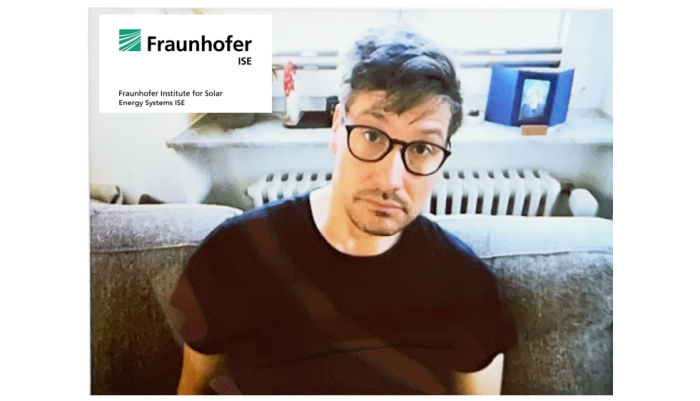
Torsten has been with Fraunhofer ISE since 2011, starting as a PhD candidate and growing into his current role as Head of Team Electrically Conductive Adhesives in the Division Photovoltaics. His journey at Fraunhofer ISE has been closely intertwined with the development of matrix shingle technology: a technology he and his team built from the ground up, with particular focus on upscaling from laboratory to pilot production. This hands-on experience in bridging research and industrial application made him the natural choice to lead his team in SPHINX, where these competencies are crucial for project success.
What was your original motivation to become a researcher/project manager?
Honestly? I wanted to make the world better and give my studies a real “purpose”: typical Generation Y, I suppose. But beyond the idealism, I discovered that I’m genuinely good at this work, and the PV sector provides exactly the kind of environment I thrive in: dynamic and constantly evolving. I love the challenge of pushing technological boundaries in a rapidly changing industry, where you need to balance fundamental research with practical implementation.
What is your (main) research area today?
Electrically conductive adhesives (ECA) are a critical technological building block for tomorrow’s solar cell interconnection, whether for tandem cells, back contact architectures, or shingle technology. These are high-tech polymers filled with conductive particles that can be processed at low temperatures. The beauty of ECAs lies in their ability to provide both gentle, material-friendly bonding and excellent electrical conductivity simultaneously. It’s a fascinating intersection of materials science, process engineering, and industrial scalability.
What is the main focus of your team in SPHINX?
Our focus is on upscaling and all the challenges that come with it: reproducibility, efficient manufacturing methods, and maintaining quality. The real challenge? Achieving all of this while still driving innovation forward. We’re essentially developing shingle and tandem module technologies in the team in parallel, which means we need to master both the art of reliable production and generating new developments at lab scale at the same time.
Could you describe your favourite moment/satisfaction when working for the project and – more in general – for your organisation?
The “aha-moment” for me was producing over 5,000 PV modules in summer 2025. I remember the early days when building just 5 modules required massive effort and careful coordination. Now we’re operating at a completely different scale – and what made it truly special was the spirit: our students, who were heavily involved in production, were dancing to music in the lab after work. Even department heads and division leaders rolled up their sleeves and helped on the production line. There was so much love poured into this production campaign. It was an experience that showed what’s possible when everyone pulls together. This energy and determination is exactly what I appreciate most about working in SPHINX: people genuinely want to push boundaries together, not just fulfill deliverables.
How do you expect SPHINX results will affect your organisation and the PV sector?
Matrix shingle technology will shape the future of building-integrated photovoltaics (BIPV). The technology’s flexibility and aesthetic possibilities make it ideally suited for architectural integration, which is exactly what BIPV needs to move from niche to mainstream. For Fraunhofer ISE, SPHINX means something equally important: bringing teams together, breaking down internal silos, and pulling in the same direction. Large collaborative projects like SPHINX force us to work across traditional boundaries. That’s when the best innovations happen.