
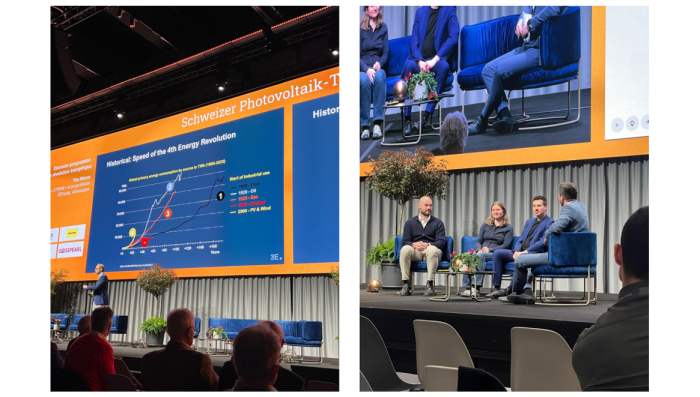
We are proud to share the joined achievement of EPFL and FSUNS: the poster, showed at PV-Tagung conference 2026 in Bern, entitled “Outdoor Performance and Degradation of Photovoltaic Roof Tiles under Realistic BIPV Operating Conditions”.
Date of achievement of result:
Result has been achieved on 31st of March 2026 (month 29 of the project.)
Short introduction
The substitution of conventional tiles with photovoltaic (PV) tiles in the built environment is promising in the field of building-integrated PV (BIPV) to promote an energy transition while maintaining the aesthetic integrity of the building envelope. Due to their non-ventilated, insulated installation environment, the PV roof tiles can suffer different degradations during operating conditions. In this study, different PV roof tile technologies are placed on a roof-like structure to study these degradations.
Newsitem
- Objective: The objective of this work is to analyse the impact of the working environment on the performance of solar roof tiles integrated on a roof-like structure.
- Research: Commercial solar roof tiles have been mounted on a homemade wooden structure to mimic the real working conditions of the solar tile. The mock-ups are then monitored outdoors with temperature sensors and electrical parameters measurements over time. Indoor IV and EL measurements were also done to correlate with the outdoor data analysis.
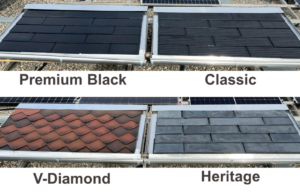
- Result: To mimic the solar tile environment, four wooden racks of dimensions 192 x 100 cm were fabricated (main picture). The base was constructed as a roof structure using wooden slats, screws, insulation sheets, and sheet metal. Depending on the technology used, 12 to 15 PV tiles per mock-up have been laid on the racks and monitored on a roof, as seen in the picture.
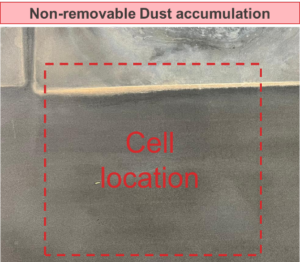
After more than one year of monitoring, V-diamond and Heritage tiles showed a higher performance loss rate (PLR), indicating that products with colors or a satinated glass were more prone to degradation. For the satinated product, it has been observed that non-removable dust accumulated on the structured glass below the overlap location. This results in prohibiting the light from reaching the cell, thus leading to a performance loss over time.
The temperatures below the tile for the roof-like structures were 4 to 9 °C higher in comparison to a typical ventilated module. These increases in temperature may lead to further degradation in the lifetime of the tiles.
So, it has been observed that temperature and accumulation of non-removable dust can lead to a higher performance loss rate. However, with innovations developed within SPHINX, such as anti-glare coatings, next-generation solar roof tiles can be produced with a dust-free, highly efficient, and stable design.
- What will it be used for: For the dissemination of the results in a poster at PV Tagung 2026.
- Impact: The poster has been exposed at PV Tagung 2026, in which more than 400 participants from the Swiss PV industry were present.