
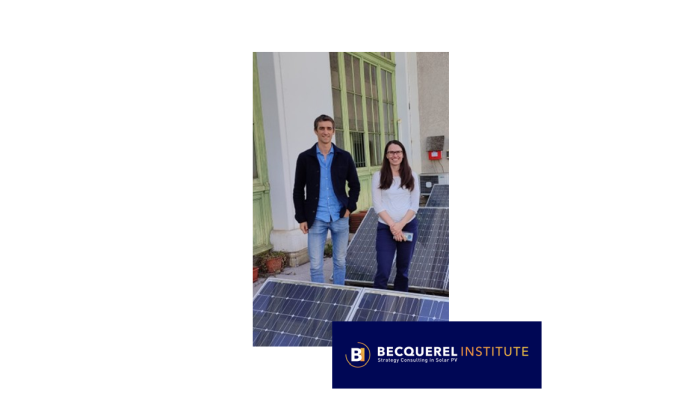
Get to know Melodie De l’Epine from Becquerel Institute France
I have been a part of the PV field since 2001 – working to build a legal and administrative framework to deploy PV on one hand, and negotiating grid connection and FiT conditions on the other. I have developed a PV resource centre, accompanied clients to evaluate their land and buildings to deploy PV, trained installers and developers, followed the PV market, worked with a team that ran operations and maintenance for a portfolio, participated in the consultative process for Frances energy transition goals. You could say I’m a generalist of everything PV related. In SPHINX I am leading the extended lifetime activity.
Get to know Jose Mari Vega de Seoane from Becquerel Institute España
I am an industrial engineer involved in the PV field since 2008, first as a researcher, project manager and group leader in TECNALIA R&I with a focus on integrated PV technologies and since 2023 as the Managing Director of Becquerel Institute España. I am currently co-leading IEA PVPS Task 15 on the Enabling Framework for the Development of BIPV. In SPHINX, I am leading WP6 – Economic, Environmental and Sustainability assessment and recommendations.
What was your original motivation to become a researcher/project manager?
JM: I started as a researcher back in 2008, I was very enthusiastic about working in renewable energies and I got lucky getting a researcher position at TECNALIA R&D where I had my first contact with photovoltaic energy. During my first years as a researcher I was mostly doing laboratory work: cell and module characteristation and thermal and mechanical simulation of PV systems. I then specialised in integrated PV and contributed to the development of a new lightweight encapsulation technology, that was later patented and successfully transferred to the industry through the creation of a start-up so called Izpitek Solar.
Melo: From a young age I was invested in positive environmental outcomes for all – though I wasn’t clear whether I wanted to work in energy, water or building sectors. I discovered solar and building performance in France and really loved it and stayed in the sector because it really is a marvellous technology, capable of meeting a growing number of human needs in the best way possible.
What is your (main) research area today?
JM: At Becquerel Institute we are supporting industrial players across the whole PV value chain, from manufacturers to developers. The services we offer are very broad and specific to each customer’s need, but we are usually providing support in analysing markets and competitiveness. For example, we help them understand what the best markets for their product/service are, what is the competitive gap with commercial benchmarks and identify the most influencing factors that could be improved to reduce it. In addition, Generative AI has now become a priority, and we are adapting our offer to this new reality with the lauch of Solarintelligence.ai. We try to align our reserach activities to the identified industrial priorities.
What is the main focus of your team in SPHINX?
JM: In SPHINX, we are working on four different topics: (1) cost and value chain readiness, we are leading Life Cycle Cost analysis and LCOE analysis for SPHINX technologies and IPV systems demonstrated in the project and analysing the readiness of the European value chain with regards to the matrix shingling technology. On the other hand, (2) we are studying the reuse, repair and recycle potential for PV systems and (3) analysing social barriers hindering the deployment of BIPV.
Melo: Having followed the PV market in France since its inception and seeing systems reach the end of their planned lifetime today, I have been very keen to see how we ensure continued operations for existing systems, and how we anticipate longer lifetimes for new products and systems. The technologies being explored in SPHINX are really great tools that can have a significant impact on our ability to provide products that can be replaced when and if necessary, and our partners, across a variety of different approaches, are all looking to the future for their end users. I am also looking at those things beyond their control – insurance, legal, competencies that could hinder repairs and reuse.
Could you describe your favourite moment/satisfaction when working for the project and – more in general – for your organisation?
JM: SPHINX is an industry-driven project and lets us be involved in an innovative PV interconnection technology. Conceptually it is quite disruptive, and it is great to see all this industrial and research ecosystem work together towards the industrialisation of the technology. I particularly enjoyed the visit to Fraunhofer-ISE and M10 where we had the opportunity to see live the impressive machine and interconnection process.
How do you expect SPHINX results will affect your organisation and the PV sector?
JM: SPHINX has brought relevant outcomes to our organisation. On the one hand, it has contributed to improve our life cycle cost modelling tool and has allowed us to compare SPHINX matrix shingling technology with the current mainstream benchmark and understand the challenges for it commercialisation in such a competitive market environment. It has also given us the opportunity to analyse its impact in the European value chain and understand its readiness and/or barriers to adopt it.
Melo: I hope that we will be able to improve end users’ knowledge of how SPHINX products can contribute to longer lasting PV systems, and bring O&M operators to look towards repair rather than early repowering. I hope to also be able to highlight, to the industry and policy makers, the importance of understanding the different constraints around long lifetimes, repairability, and reuse.